

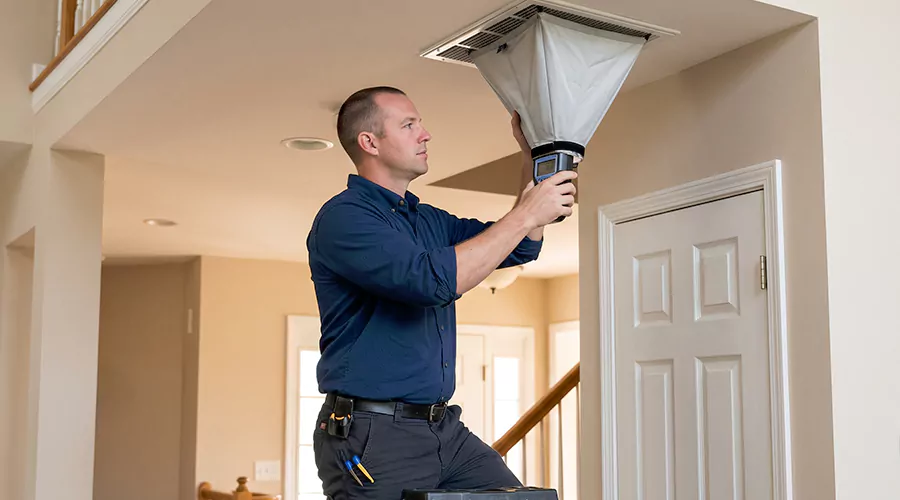
HVAC air balancing can cost approximately $200 to $2,000 for many residential projects, depending on the size of the home, number of vents, testing requirements, and complexity of the adjustments. A straightforward balancing service may cost $200 to $600, while detailed whole-house testing and balancing can cost $750 to $2,000. HVAC duct cleaning may be recommended separately when inspections reveal dust or debris buildup that requires removal from the ductwork.
Professional air balancing involves measuring and adjusting airflow so rooms receive the amount of heated or cooled air required for comfort. When a system is poorly balanced, some rooms may receive excessive airflow while others remain uncomfortable. A bedroom may stay warm during summer even though the living room feels cold.
Balancing can correct certain distribution problems without replacing the HVAC equipment. However, major duct leaks, undersized ducts, and inadequate return-air pathways may require additional repairs. Understanding the different service costs can help homeowners compare estimates and determine whether professional balancing is worthwhile.
What Is the Average HVAC Air Balancing Cost in 2026?
Published estimates vary because companies define air balancing services differently. Angi's July 2026 guide estimates approximately $750 to $2,000 for whole-house professional balancing. PickHVAC's October 2026 estimate places many standard residential balancing projects around $200 to $600, with a typical bill near $400.
| HVAC Air Balancing Service | Estimated U.S. Cost |
|---|---|
| Basic residential air balancing | 200–600 |
| Whole-house professional balancing, Angi | 750–2,000 |
| Individual damper adjustment, Angi estimate | 75–150 |
| Complex or multizone balancing, PickHVAC | 500–1,500 |
| Residential airflow testing and written balance report | 300–800 |
These ranges describe different service scopes and should not be added together.
A technician making several simple damper adjustments may charge substantially less than a contractor performing complete airflow measurements and producing a detailed report.
What Factors Affect HVAC Air Balancing Prices?
1. Home Size
Larger homes often contain more supply registers, return grilles, and duct branches. Measuring and adjusting airflow throughout a large property can require additional labor. However, square footage is not the only pricing factor. A compact house with multiple HVAC systems may be more complicated than a larger home served by one straightforward duct network.
2. Number of Supply and Return Vents
Each register may need airflow measurements during detailed balancing. Homes with numerous outlets require more testing and adjustment time. A quote should identify whether every register will be measured or only selected rooms with comfort complaints. Per-register pricing can be useful for estimating labor, but most contractors also charge for setup, travel, and system evaluation.
3. Number of HVAC Systems
A home with two furnaces or separate upstairs and downstairs air handlers may require independent balancing procedures. Each system has its own blower performance, duct network, and airflow requirements. Multiple systems can increase the total price, particularly when detailed measurements are required.
4. Duct Accessibility
Balancing dampers are often installed near branch connections in attics, basements, and crawlspaces. Accessible dampers can be adjusted more easily than those concealed behind finished ceilings.
Additional labor may be necessary when a technician must locate dampers or inspect difficult duct routes. Creating new access openings or installing missing dampers may involve separate charges.
5. Existing Duct Problems
Air balancing cannot always correct damaged or poorly designed ductwork. A disconnected branch, crushed flexible duct, or undersized return may require repair before airflow can be balanced effectively.
ENERGY STAR reports that typical residential duct systems can lose approximately 20% to 30% of moving air through leaks and poor connections. Sealing or replacement costs should be identified separately from balancing labor.
What Is Included in Professional HVAC Air Balancing?
A thorough service generally includes evaluating existing airflow and making suitable adjustments.
Typical work may involve:
- Inspecting the HVAC filter and accessible equipment.
- Checking supply and return registers.
- Reviewing the duct layout.
- Measuring airflow at selected outlets.
- Measuring relevant static pressure.
- Checking manual balancing dampers.
- Adjusting airflow distribution.
- Investigating significant return-air restrictions.
- Rechecking airflow after adjustments.
- Documenting the final results when included.
The exact scope varies by company. Ask whether the contractor provides actual cubic feet per minute readings, abbreviated CFM, or only makes adjustments based on temperature complaints.
What Equipment Is Used for Air Balancing?
Technicians use specialized instruments to evaluate airflow.
An airflow capture hood can measure air passing through a register. An anemometer measures air velocity, while a digital manometer measures pressure differences. A professional HVAC Inspection Service can use these measurements to evaluate airflow, identify potential restrictions, and assess overall heating and cooling system performance.
Static pressure testing helps identify excessive resistance in the duct network. Temperature measurements can also provide useful information, although room temperatures alone cannot establish whether airflow is balanced. The technician should compare measurements with the heating and cooling requirements of each room.
How Long Does HVAC Air Balancing Take?
A basic residential balancing appointment may take approximately one to three hours when dampers are accessible and no major problems are present. A detailed whole-house evaluation may require longer, especially with numerous registers or multiple air handlers.
Additional time may be needed when duct defects, inadequate returns, or equipment problems are discovered. Ask whether the contractor expects to complete testing and adjustments in one visit.
Can You Balance HVAC Airflow Yourself?
Homeowners can correct basic obstructions before hiring a professional. Start by opening registers, replacing dirty filters, and removing furniture from return grilles. You can also note which rooms experience persistent temperature differences.
However, accurate balancing requires airflow measurements and an understanding of how changes to one branch affect the rest of the system. Randomly closing supply registers can increase duct pressure and interfere with system performance.
Is Professional Air Balancing Worth the Cost?
Professional balancing can be worthwhile when airflow is uneven but the existing ducts and equipment are otherwise capable of serving the rooms. The U.S. Department of Energy explains that balancing dampers and adequate return pathways help maintain appropriate room airflow.
A properly balanced system can improve comfort without requiring additional heating and cooling equipment. However, balancing does not guarantee energy savings or correct every temperature problem. Insulation deficiencies, solar heat gain, and undersized ducts may need separate attention.
Does Air Balancing Lower Energy Bills?
Balancing may improve system operation when poor airflow distribution contributes to inefficient heating or cooling. However, savings depend on the cause of the original problem. If substantial conditioned air escapes through leaking ducts, sealing those leaks may be more important than adjusting dampers.
If a room remains hot because of inadequate insulation, balancing alone may offer limited improvement. A qualified contractor should explain what the service is expected to change without promising a specific reduction in utility bills.
Air Balancing vs. Duct Cleaning: What Is the Difference?
Air balancing measures and adjusts the distribution of conditioned air. Duct cleaning removes accumulated debris from HVAC passages and applicable equipment components. These are different services.
Cleaning may improve airflow when substantial debris is physically obstructing a duct, but ordinary surface dust usually does not justify cleaning solely for balancing purposes. Likewise, adjusting dampers cannot remove contamination or repair broken ducts. Choose the service based on the actual condition of the system.
How Can You Save Money on Air Balancing?
Start with basic maintenance to eliminate preventable restrictions. Then request written estimates from several qualified HVAC contractors. Ask whether the proposal includes static pressure testing, register airflow measurements, damper adjustments, and a final report.
If you already have a scheduled HVAC maintenance visit, ask whether an airflow assessment can be performed during the same appointment. Avoid paying for full-system balancing when the actual problem is a single disconnected or crushed branch.
When Should You Schedule Air Balancing?
Balancing may be appropriate after replacing major HVAC equipment, installing new ductwork, or modifying room layouts. It can also help when some rooms consistently receive too much or too little conditioned air. Persistent temperature differences between floors may justify a broader airflow assessment.
There is no universal requirement for annual residential air balancing. Reassessment is most useful when the system or building conditions change.
Conclusion
HVAC air balancing costs vary considerably, from a few hundred dollars for basic adjustments to approximately $2,000 for more detailed whole-house services. Home size, vent count, duct accessibility, and testing requirements influence the total price. Professional balancing can improve room comfort when the existing duct network is capable of delivering the required airflow. Compare itemized estimates and confirm whether measurements, repairs, and final reporting are included.